When to Stop Mowing the Lawn Before Winter
Written in central Wisconsin, October 2026, from a 10,000-square-foot Kentucky bluegrass lawn. Everything below is cool-season logic — if you have bermuda or zoysia, the calendar is inverted, and the height advice doesn’t apply to you.
Most people stop mowing too early, and they stop for the wrong reason. The first hard frost arrives, the lawn looks finished, the mower goes in the shed.
Frost doesn’t stop cool-season grass. On a Kentucky bluegrass lawn in the upper Midwest, the last cut usually comes after the first frost, not before it — sometimes weeks after. And the grass you leave standing because you quit early is the grass that mats under snow and comes out of winter diseased.
There’s a real trigger for when to stop mowing the lawn; it isn’t a date, and you can check it without buying anything.
When to Stop Mowing the Lawn: The Actual Trigger
Iowa State Extension puts it plainly: the foliage of cool-season grasses stops growing when daytime high temperatures are consistently below 50 degrees.
The word carrying the weight there is consistently. One cold snap followed by a mild week restarts growth, and a lawn that’s growing needs mowing. In central Wisconsin, that threshold usually lands somewhere between late October and mid-November, and it moves by a couple of weeks year to year.
Underneath the air temperature is the number that actually governs the plant. Growth slows sharply once soil temperature drops below 50°F and effectively stops around 40°F. Soil lags air by a long way — it holds heat, so it falls slowly and keeps the lawn growing well past the first frost.
How to Check Soil Temperature Without Buying Anything
A soil thermometer costs about ten dollars and is the accurate answer. But you don’t need one to get close.
Soil temperature at root depth runs roughly ten degrees below the average daily air temperature over the previous couple of weeks. Not the high — the average of highs and lows, across fourteen days or so.
So if the last two weeks have averaged 55°F, your soil is sitting somewhere near 45°F, and the lawn is nearly done. If they’ve averaged 62°F, soil is around 52°F, and you have cutting left to do no matter how cold last Tuesday felt.
Pull up the two-week history on any weather app, eyeball the average, subtract ten. It takes thirty seconds, and it beats guessing from the calendar.
The Ten-Day Test
The simplest confirmation, and the one I actually use.
After a cut, leave the lawn alone and look at it ten to fourteen days later. If it’s noticeably taller, it’s still growing, and it still needs mowing. If it looks the same height it did when you finished, growth has stopped, and that cut was your last.
No thermometer, no app, no argument. The lawn tells you.
Walk the Height Down, Don’t Drop It
Here’s where most advice goes wrong in one direction or the other. One camp says scalp it for winter. The other says change nothing. Both are wrong, and the right answer is a process rather than a number.
Finish the season at the low end of your grass’s normal range — around 2.5 inches for Kentucky bluegrass, a little more for tall fescue. Not shorter. A scalped lawn goes into winter with its crown exposed and its reserves stripped, which is a worse problem than the one you were trying to solve.
And get there gradually. The one-third rule doesn’t take the winter off. Dropping from 3.5 inches to 2.5 inches in a single cut removes nearly 30 percent of the blade on a lawn that’s already shutting down and can’t recover.
Step it down across your last two or three mows:
- Third-to-last cut: 3 inches
- Second-to-last: 2.75 inches
- Last cut: 2.5 inches
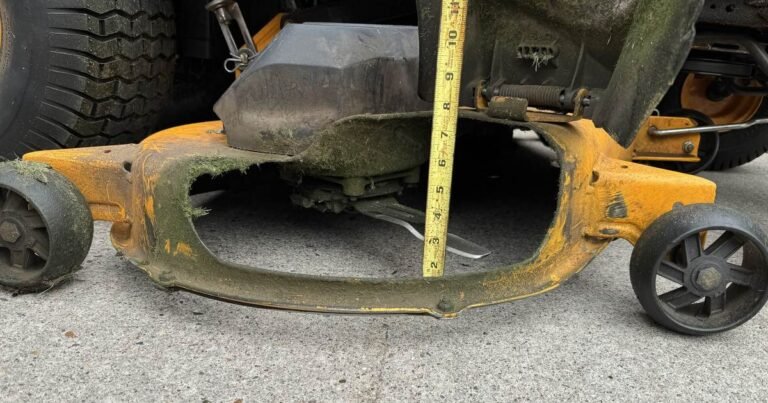
Half an inch at a time, no drama. If you don’t know what your deck setting measures actually is — and the number on the lever is not the height it cuts — the mowing height article covers how to put a tape on it.
Why the Last Cut Height Matters: Snow Mold
This is the whole reason the final height is worth thinking about, and it’s a bigger deal here than it is in most of the country.
Snow mold is a fungal disease that develops under snow cover on unfrozen ground, in the 32 to 60 degree range, where turf stays wet and dark for months. Wisconsin provides those conditions better than almost anywhere. It comes in two forms: gray snow mold, which is the milder one, and pink snow mold, which attacks roots and crowns and does real damage.
Long grass is what gives it a home. Blades that are too tall fold over under the first wet snow and mat into a dense, damp layer that holds moisture against the soil all winter. That mat is the habitat.
Two other things you can do about it while you’re thinking about the last cut:
- Don’t put down a heavy nitrogen application right before the first lasting snow. Succulent late growth is exactly what the fungus prefers. Your late-fall feeding should be done by about the time growth stops, not after.
- Don’t leave a mat of anything. Leaves, grass clippings in rows, piles from the last leaf cleanup — all of it does the same job as long grass. What to do with leaves on your lawn covers getting the lawn visibly clear before it freezes.
Work Out Your Last Cut
Is This Your Last Mow?
Three answers from what the weather has actually been doing, not from the calendar. It returns whether to keep mowing and what height to cut at from here.
Where that temperature comes from: open the two-week history in any weather app and eyeball the average of the highs and lows. Soil at root depth sits roughly ten degrees below it — below 50°F growth slows sharply, below 40°F it stops.
What Else Belongs in the Final Pass
The last mow of the season is the one time everything lines up, so do all of it at once:
- Mulch whatever leaves are left. Deck at the top for that, then back down for the cut.
- Leave the clippings. They’re short at this point, and they return nitrogen.
- Check that the lawn is visibly clear when you’re done. Fragments are fine. A layer is not.
- Scrape the deck before it sits all winter with caked grass curing onto it.
- Then winterize the mower — fuel, battery, blade. Twenty minutes in November saves a repair bill in April, and that’s its own article in a few weeks.
[YOUR PARAGRAPH — Delete These Brackets]
Three or four sentences on your own last cut. Roughly what date it landed last year, whether you’d been stopping at the first frost before, what the lawn looked like in April if you left it long. Your lever numbers are the specific detail here — what you step down to and what that actually measures. Firsthand and specific; this is the paragraph nobody else can write.
Four Things Not to Do
- Don’t stop at the first frost. Frost doesn’t end cool-season growth. The last cut normally comes after it, sometimes weeks after.
- Don’t scalp it for winter. Low end of the normal range, not below. An exposed crown is a worse winter problem than a slightly long lawn.
- Don’t drop the whole height in one cut. The one-third rule still applies to a lawn that’s shutting down and can’t repair itself.
- Don’t mow frozen or frost-covered grass. Frozen blades shatter rather than bend, and the wheels bruise crowns. Wait until it thaws in the afternoon.
The Short Version
- Mow until growth stops, and growth stops when daytime highs sit consistently below 50°F — usually late October to mid-November in the upper Midwest
- Soil runs about ten degrees below the two-week average air temperature; below 50°F growth slows, below 40°F it stops
- If the lawn is the same height ten days after a cut, that cut was the last one
- Finish at the low end of your range, around 2.5 inches for bluegrass, reached over two or three mows
- The reason is snow mold — long grass mats under snow and gives it somewhere to live
- Frost is not the signal, and it never was