
How Short to Cut Grass: The Setting Most People Get Wrong
Written in central Wisconsin, September 2026, from a 10,000-square-foot Kentucky bluegrass lawn. Heights below cover both cool-season and warm-season grasses — the difference between them is larger than any other variable in this article.
Cutting the grass too short is the most common lawn mistake there is, and it’s the only one that’s free to fix. No product, no application, no waiting. You turn a dial on the mower and the lawn gets better.
The reason it’s so common is that the reasoning behind it sounds right. Cut it shorter, mow less often, tidier yard. Every part of that is wrong, and the last part is wrong in a way that’s easy to prove.
How Short to Cut Grass, by Type
There isn’t one right height. There’s a right height for what’s growing in your yard, and the gap between a bluegrass lawn and a zoysia lawn is nearly three inches.
| Grass | Mowing height | Mow when it reaches |
|---|---|---|
| Kentucky bluegrass | 2.5–3.5″ | 3.75–5.25″ |
| Tall fescue | 3–4″ | 4.5–6″ |
| Fine fescue | 2.5–4″ | 3.75–6″ |
| Perennial ryegrass | 2–3.5″ | 3–5.25″ |
| Bermuda | 1–2″ | 1.5–3″ |
| Zoysia | 0.75–2″ | 1.1–3″ |
| St. Augustine | 2.5–4″ | 3.75–6″ |
| Centipede | 1–2″ | 1.5–3″ |
If you’re in the northern half of the country, you almost certainly have one of the first four, often a blend of several. If you don’t know which, the blades will tell you — that’s a separate article.
Within each range, go toward the high end in shade, on sandy soil, during summer heat, and any time the lawn is under stress. Go toward the low end only on a dense, healthy, irrigated lawn in cool weather.
The One-Third Rule, Done in Actual Inches
The rule every article states: never remove more than a third of the blade in one cut.
The part they leave out is what that means in practice. If your target height is 3.5 inches, a third of the blade is removed when the grass reaches 5.25 inches — that’s your mow-when number. Not when it looks shaggy. Not Saturday.
The arithmetic is your target height divided by two-thirds, or multiplied by 1.5 if that’s easier:
- Cutting at 2.5″? Mow when it hits 3.75″
- Cutting at 3″? Mow when it hits 4.5″
- Cutting at 3.5″? Mow when it hits 5.25″
- Cutting at 4″? Mow when it hits 6″
Break the rule and you scalp. Removing more than a third at once strips away so much leaf surface that the plant can’t photosynthesize enough to support its own roots, so it sheds root mass to compensate. That’s not a metaphor — the roots physically die back within days of a hard cut. A lawn scalped repeatedly has a root system a fraction of the depth it should.
The practical consequence: mowing height is root depth. Roughly speaking, a plant’s root system mirrors what’s above ground. Three and a half inches of leaf supports several inches more root than two inches of leaf does, and that root depth is what determines whether the lawn survives August.
Find Out What Your Mower Is Actually Cutting
Here’s the section nobody writes, and it’s the one that matters most. The number on your mower’s height adjuster is not the height it cuts at. It’s a position on a lever, and it can be off by half an inch or more — from wear, from tire pressure, from a deck that was never level to begin with.
So measure it. Ten minutes, once, and then you actually know.
- Disconnect the spark plug. Before anything else, every time.
- Roll the mower onto a flat concrete surface — garage floor or driveway. Grass gives under the wheels and ruins the measurement.
- Check tire pressure first if it’s a riding mower. Soft tires drop the deck.
- Rotate the blade so one tip points straight forward.
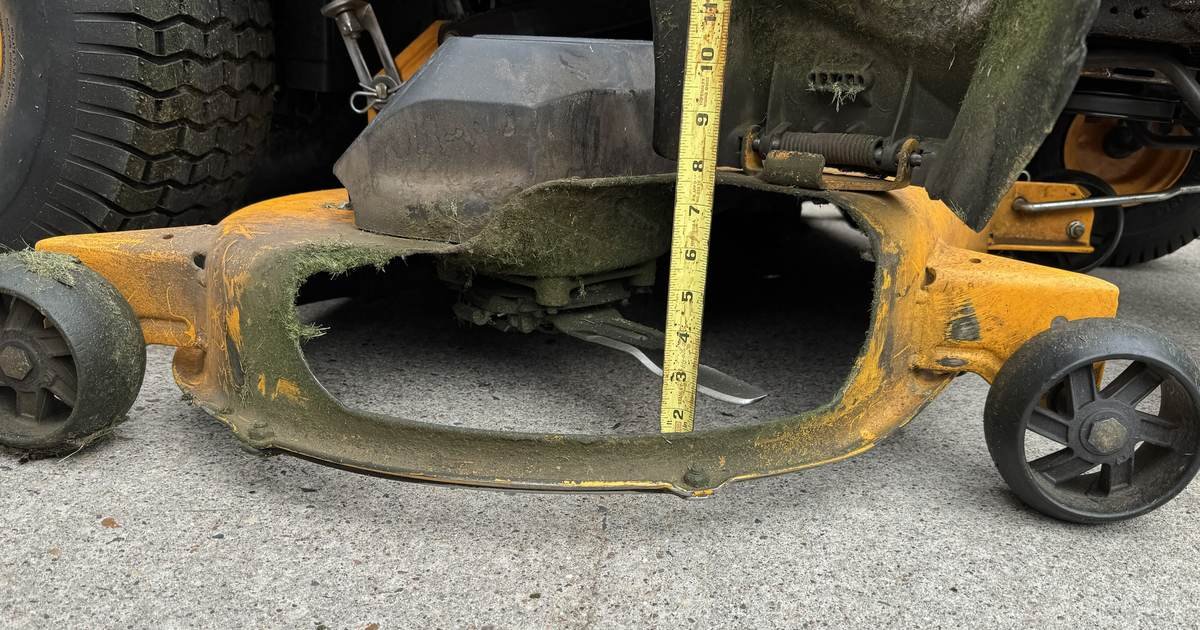
- Measure from the concrete to the blade tip’s cutting edge. That number is your real cutting height.
- Now rotate the blade 180 degrees and measure the other tip at the same spot. The two should match within about an eighth of an inch.
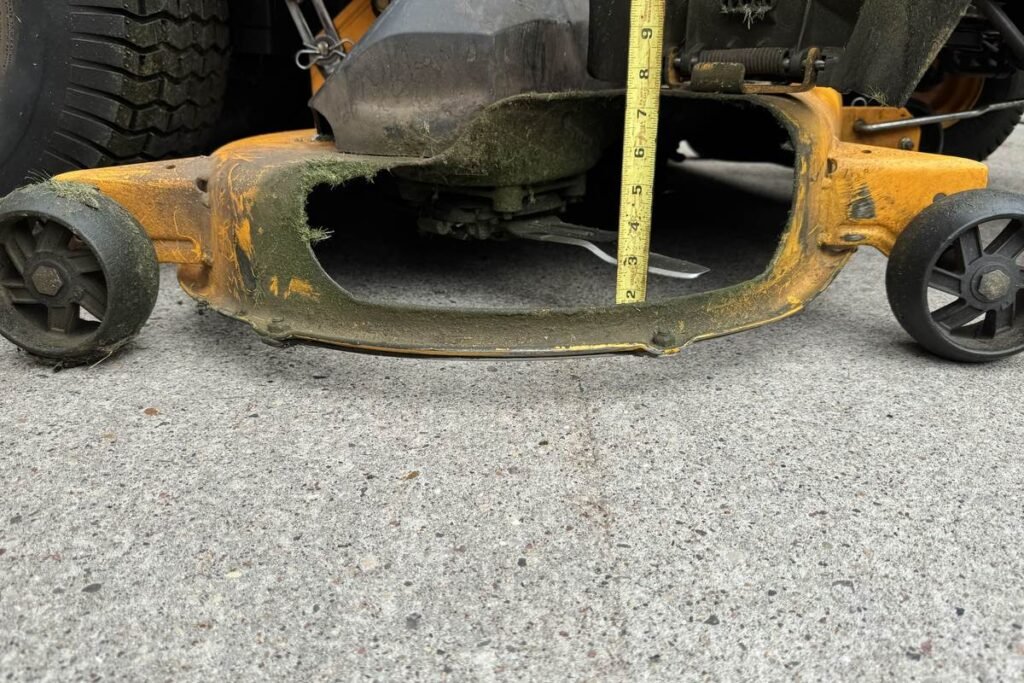
Write the real number next to each lever position on a piece of tape on the deck. You’ll use it every time you change height for the rest of the mower’s life.
While You’re Down There: Level the Deck
Two checks, both rarely done on home mowers, both responsible for lawns that look striped or uneven no matter what height you set.
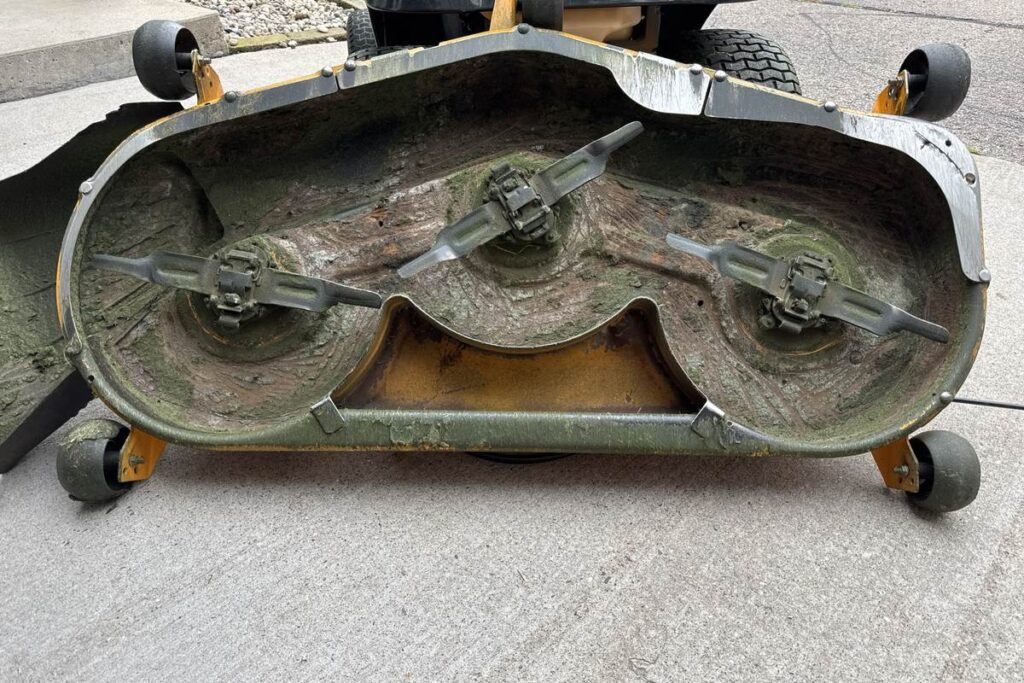
Side to side. Rotate the blade so it points left-right, and measure both tips from the floor. They should be within an eighth of an inch. If one side sits lower, that side is cutting shorter, and you’ll see it as a lighter stripe across the lawn.
Front to back — the deck rake. Rotate the blade front-to-back and measure both tips. The front should sit about an eighth to a quarter inch lower than the rear. That slight forward pitch is deliberate: it lets the front edge cut cleanly and the rear discharge without recutting clippings into dust. A deck that’s level front-to-back, or tilted backward, gives you a ragged cut and clumping no matter how sharp the blade is.
Both adjustments are usually a nut on the deck hangers. Your mower’s manual will show which.
Why Cutting Short Doesn’t Save You Time
This is the belief that keeps the deck low, and it’s backwards.
Grass grows from the crown at the base, not from the tip, and its growth rate responds to how much leaf it has. A lawn cut short has less leaf area, so it responds by pushing new growth hard to restore it. A lawn cut tall has plenty of leaf and grows more slowly.
Then run the one-third rule against both. Cut at 2 inches, you’re back out at 3. Cut at 3.5, you’re not out until 5.25 — and it takes longer to get there, because it’s growing more slowly to begin with. The tall lawn buys you more days between mows, not fewer.
What Height Actually Does For You
Four things, and the first one is the reason to care.
It shades out weeds. Crabgrass seed needs light at the soil surface to germinate. A dense canopy at three and a half inches doesn’t let enough light through, and the seed sits there dormant. This is the cheapest weed control that exists, and it works before the weed does, which no herbicide can claim.
It holds moisture. Taller grass shades its own soil, and shaded soil loses less water to evaporation. The same lawn cut at 3.5 inches needs measurably less irrigation than one cut at 2.
It survives summer. Deeper roots reach water that shallow roots can’t, which is why short-cut lawns go brown first in July and tall-cut lawns in the same neighborhood stay green.
It hides imperfection. A taller canopy conceals thin spots, minor damage, and uneven ground that a short cut puts on display.
Raising the deck does more for color and density than the fertilizer most people reach for first. It’s also free, which is the part that should be persuasive.
Seasonal Adjustments
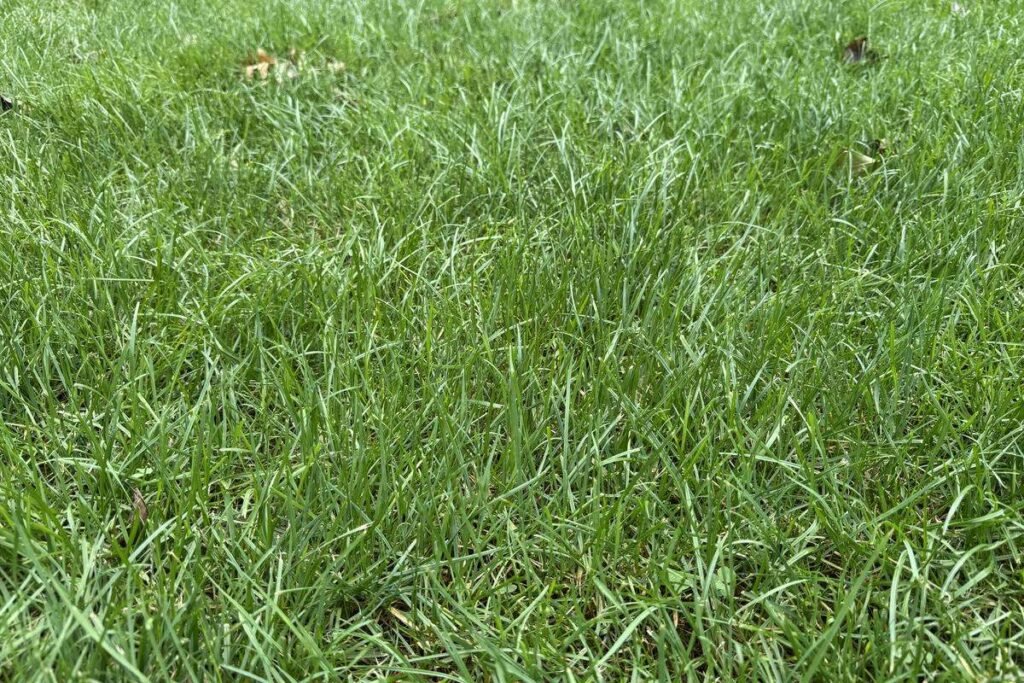
Spring: start at the low end of your range for the first cut or two, once growth is active. Removing winter-damaged tissue helps the lawn green up. Don’t scalp it — low end of the range, not below it.
Summer: raise to the top of your range before the heat arrives, not after the lawn is already struggling. This is the single most valuable height change in the year.
Fall: back to the middle of the range as temperatures drop and growth picks up again.
The last cut: take it down toward the low end of your range for the final mow of the season. Long grass mats under snow and gives snow mold somewhere to live. Don’t scalp it — a half inch lower than usual is enough.
A Sharp Blade Is Half of This
Height and blade condition work together, and the right height with a dull blade still gives you a lawn that yellows after every mow. A dull mower tears rather than cuts, and the shredded tips brown within a day — which across a whole lawn reads as a pale haze.
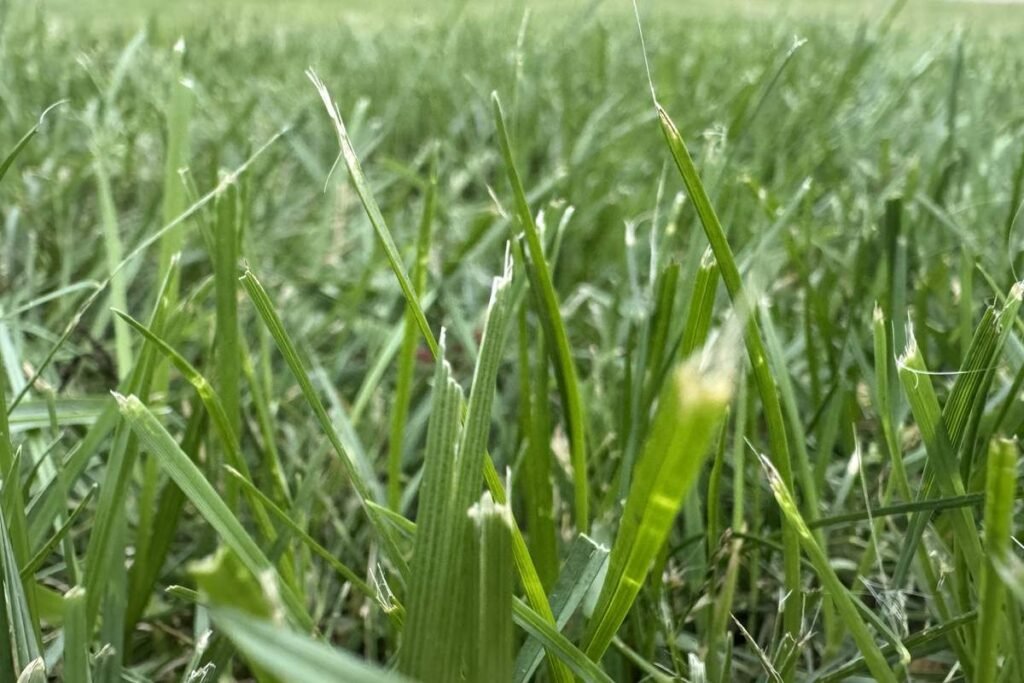
If your lawn goes yellow a day or two after mowing, the deck isn’t the problem. Why your grass is turning yellow covers how to tell the difference, with a photo of what torn tips actually look like.
Check Your Height in Thirty Seconds
What Height Should You Be Cutting At?
Pick your grass and the season. It returns your target height, the height to mow at under the one-third rule, and what to check on the mower.
- Disconnect the spark plug.
- Roll onto concrete — grass gives under the wheels and ruins the measurement.
- Rotate a blade tip forward, measure floor to cutting edge. That’s your real height.
- Rotate 180° and measure the other tip. Should match within 1/8″.
- Turn the blade side to side: both tips within 1/8″ of each other.
- Turn it front to back: the front should sit 1/8″ to 1/4″ lower than the rear.
Four Things Not to Do
- Don’t drop the deck to catch up on a lawn that got away from you. Cut a third off, wait three days, cut again. Two passes beat one scalping every time.
- Don’t mow wet grass. It tears instead of cutting, clumps in the deck, and wet clippings mat on the surface and smother what’s underneath.
- Don’t bag your clippings. Returned clippings supply roughly a quarter of the nitrogen your lawn needs for the year, free. They don’t cause thatch — that myth won’t die, but thatch comes from stems and roots, not leaf tissue.
- Don’t mow the same direction every week. Wheels compact the same lines and blades lean the way you always push. Alternate the pattern.
What My Own Mower Actually Cuts At
My mower’s height lever is numbered 1 through 9, and none of those numbers are measurements. I run between 6 and 7. On concrete with a tape, 6 measures 2.5 inches and 7 comes in at 3 — roughly a half inch per notch. I’ve since written the real inches on the deck next to each position, which took ten minutes and means I now know what I’m actually cutting at. It also showed me I’ve been running at the low end of where bluegrass wants to be. Next season I’m starting at 7 and going to 8 for the summer, and I’ll report back on whether it makes the difference the research says it should.
Where to Check This
UW–Madison’s Division of Extension publishes lawn maintenance guidance for Wisconsin conditions, and their Learning Store has free publications covering mowing and turf care. Turf researchers write university extension material with no product to sell, which makes it a better reference than most of what a search returns.
The Short Version
- Most cool-season lawns want 3 to 3.5 inches; warm-season grasses want far less
- Mow when the grass is 1.5× your target height, not on a day of the week
- The number on your mower’s lever is not the height it cuts — measure it on concrete with the plug disconnected
- Check that the deck is level side to side, and pitched an eighth to a quarter inch lower at the front
- Cutting shorter makes you mow more often, not less
- Raising the deck does more for weeds and drought than most of what’s in the lawn aisle, and it’s free
If the height is right and the lawn is still thin, the next question is what’s in the soil — what the numbers on a fertilizer bag mean covers feeding, and how to overseed a patchy lawn covers filling it in.
The Lawn Product Checklist
What to actually buy, what to skip, and what the label should say — a one-page checklist you can take to the store.