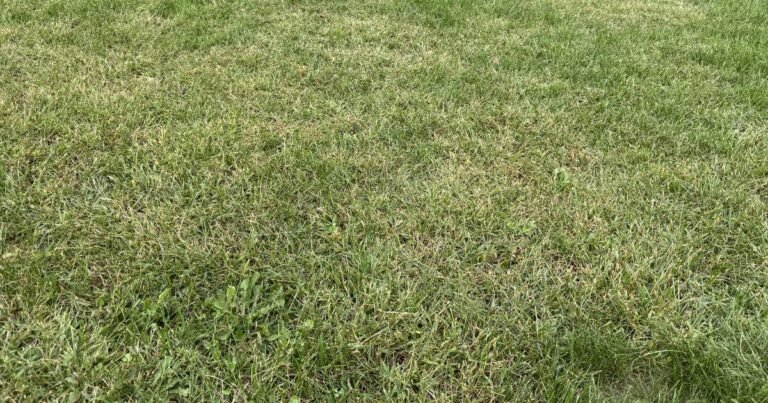
Brown Patches in Your Lawn: What the Month Tells You
Written in central Wisconsin, October 2026, from a 10,000-square-foot Kentucky bluegrass lawn. The seasonal logic below is for cool-season grass in the upper Midwest — the causes are the same further south, but the calendar is not.
Brown patches in your lawn have maybe eight common causes, and almost every article about them gives you the same undifferentiated list. Grubs, disease, drought, dog, chemical burn- pick one.
That list is not wrong. It’s just missing the single most useful filter there is, which is the calendar. The same brown patch in the same lawn means something different in July than it does in October, because the things that cause it are not active at the same time of year. Half the list can be eliminated before you kneel, just by knowing what month it is.
So that’s where this starts.
First: What Month Is It?
Cool-season lawns in the north run on a fairly strict schedule, and so do the things that damage them.
| When you see it | Most likely causes | Largely ruled out |
|---|---|---|
| April–May | Snow mold, winter desiccation, salt damage near drives and walks, vole runs | Grubs, summer disease, drought |
| June–August | Drought and dormancy, summer fungal disease, fertilizer burn, dull-blade scalping, dog spots | Snow mold, salt, grub damage (feeding has barely started) |
| September–October | Grubs, dog spots, leaf smothering, drought stress carried over from August, scalping | Snow mold, salt, most summer disease |
| November–March | Dormancy (not damage), matting under snow, traffic on frozen turf | Nearly everything — the lawn isn’t growing, so it also isn’t dying in new ways |
If you’re reading this in October with a fresh brown patch in your yard, the odds have already shifted hard toward a short list: grubs, a dog, leaves, or damage from the summer that never recovered.
A Note on the Words “Brown Patch”
Worth clearing up, because it causes real confusion and almost no one mentions it.
Brown Patch is the name of a specific fungal disease, caused by Rhizoctonia solani. It’s a hot-weather disease — it needs warm, humid nights, in the 70s, with the turf staying wet for hours. In Wisconsin that’s a July and August problem, and a mild one in most years.
brown patches, lowercase, is what everyone actually means when they type it into a search bar: a brown spot in the lawn, cause unknown.
Those are different things, and a lot of search results blur them. If it’s October in the north and something in your lawn has gone brown, it is almost certainly not Brown Patch the disease. Don’t let an article about summer fungus send you to buy a fungicide for a grub problem.
Four Tests That Identify Brown Patches in Your Lawn
Four checks, none of which require buying anything. Do them in this order.
1. The tug test. Grab a handful of the affected turf and pull straight up with moderate force. Healthy turf resists — the roots hold. Turf whose roots have been eaten off lifts away like a loose rug, sometimes in a sheet you can roll back. Nothing else in a lawn does that. If it lifts, go to test two. If it holds, you can rule grubs out and move on.
2. The square-foot dig. Only if the turf lifted. Cut and fold back one square foot of sod at the edge of the damage, and count the white C-shaped larvae in the top two or three inches of soil. The number matters more than their presence — a few grubs are in nearly every lawn and do no harm. The treatment threshold most extension services use is somewhere between five and ten grubs per square foot. Below that, the grubs are not your problem and something else caused the patch.
3. The edge test. Look at the boundary of the brown area. A sharp, clean edge with no transition usually means something was applied, spilled, or deposited — fertilizer, gasoline, de-icer, urine. A soft, feathered edge that grades into stressed grass usually means a growing condition: water, soil depth, disease, compaction.
4. The pattern test. Step back far enough to see the whole shape. Circles and rings point one direction. Stripes and arcs that match the way you walk point at the spreader or the mower. Irregular blobs that spread week over week point at something living.
The Specific Tells
Grubs. Turf lifts like carpet, feels spongy underfoot, damage is irregular and expands through September and October. Often worst in sunny open areas where the beetles laid eggs in midsummer. Sometimes you’ll see secondary damage from skunks, raccoons, or birds tearing the turf up to get at them, which looks dramatic and is actually a useful confirmation.
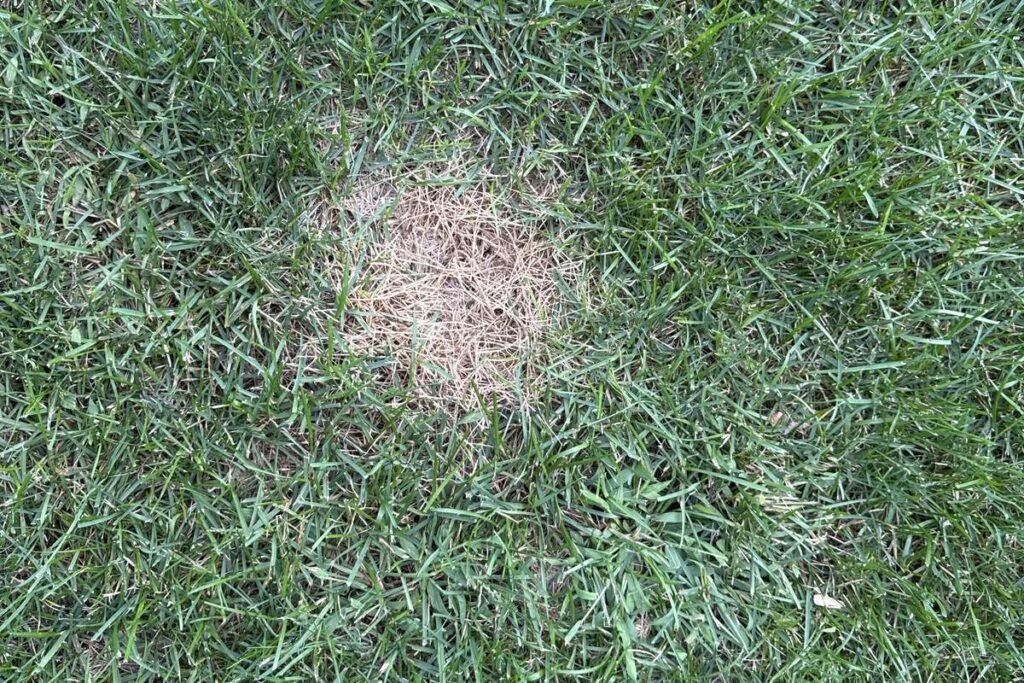
Dog urine. Roughly circular, often with a ring of darker green grass around a dead center. The ring is the diagnosis — concentrated nitrogen burns at the middle and fertilizes at the diluted edge. One caveat from my own yard: where a dog goes every single day, the whole area gets a full dose, and there’s no ring at all, just a dead patch. Why your grass is turning yellow covers that one in more detail.
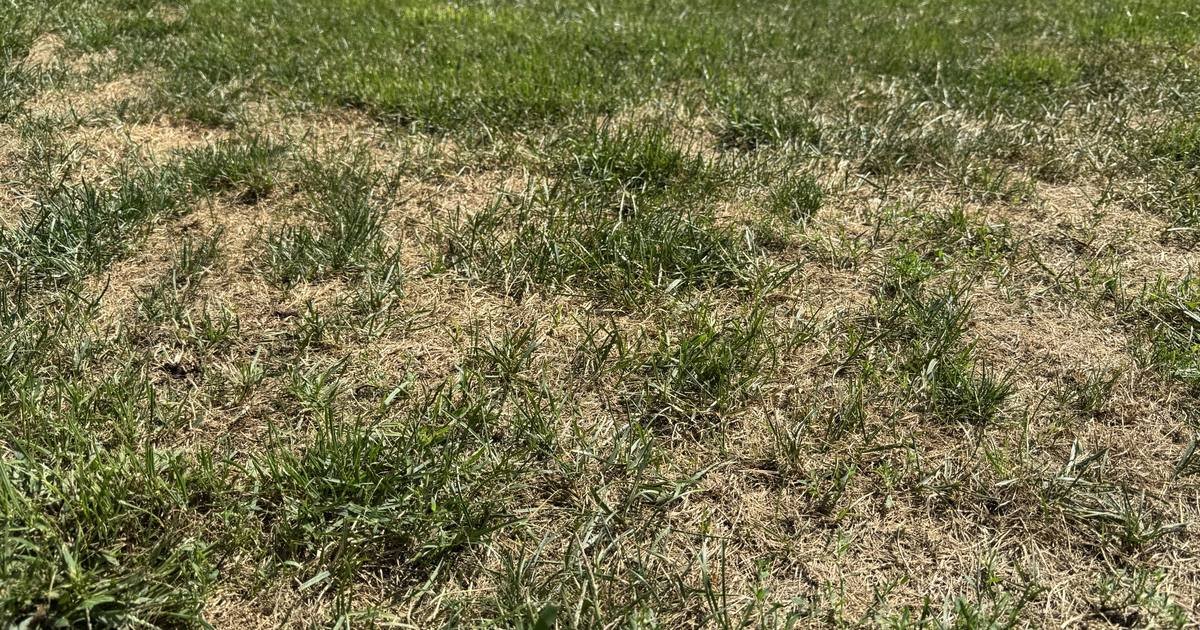
Drought and shallow soil. Shows up first on slopes, along driveways and sidewalks, and over buried rock, rubble, or construction debris. The tell is that it’s in the same place every dry spell. Push a long screwdriver in — if it stops at two inches in those spots and goes six inches elsewhere, you’ve found your answer, and it’s about soil depth rather than anything you can spray.
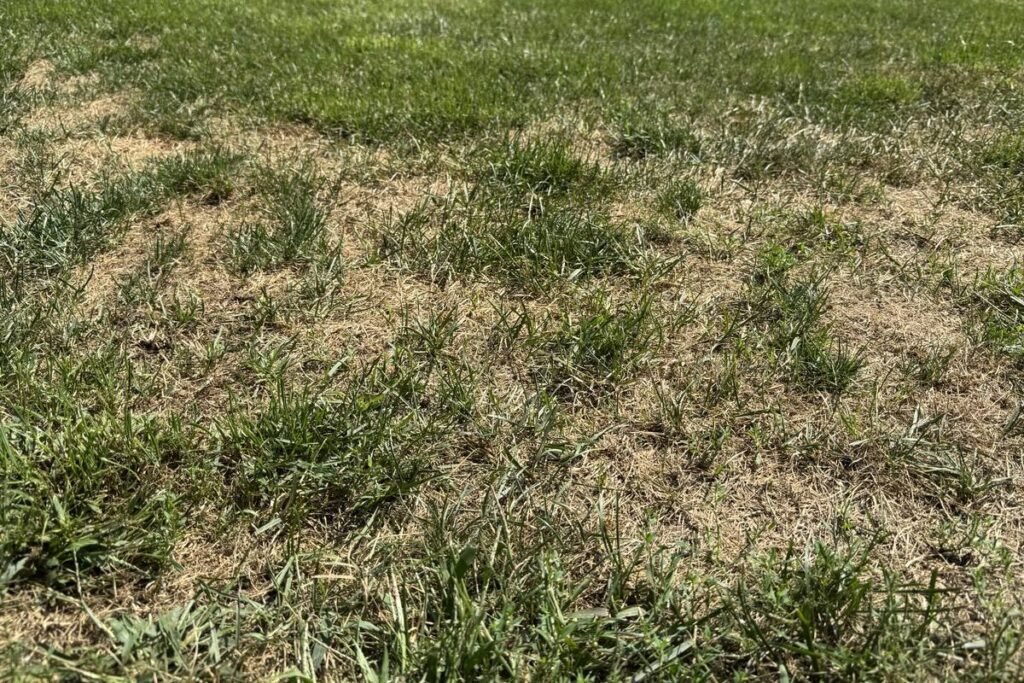
Fertilizer or chemical burn. Sharp edges, often in stripes or arcs matching a spreader pass, or a distinct footprint where something was spilled or where a mower was parked and leaked. Appears within days of the application rather than gradually.
Scalping. Brown on the high points — the crown of a slope, a hump, a tree root ridge — while the low ground stays green. That’s the mower deck bottoming out, not a disease. It’s a height and deck-setting problem, covered in the mowing height article.
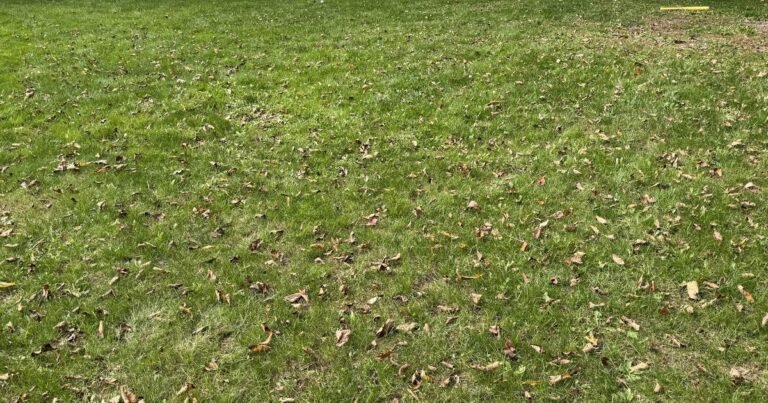
Leaf smothering. A newly brown area under where a pile of leaves sat for a week or two. Sharp-edged, matches the shape of the pile, and the grass underneath is pale and limp rather than crisp. What to do with leaves on your lawn covers getting ahead of this.
Fungal disease. Defined margins, sometimes rings or arcs, usually appearing after a stretch of warm, humid nights. Look early in the morning, before the dew burns off, for fine webbing across the blades. Mostly a summer problem in this climate.
Find Out What You’re Looking At
What’s Killing That Patch?
The month rules out half the causes before you start, so it asks that first. Everything after it is something you can check standing in the yard.
The Grub Timing Trap
This is the part worth the whole article, because it’s where people lose money every October.
You find grubs in the fall. You go to the store, buy a bag that says grub control, spread it, water it in, and nothing happens. The damage keeps spreading. The usual conclusion is that the product was junk.
The product was probably fine. It was the wrong product for the month.
Preventive grub products — the active ingredients to look for are chlorantraniliprole and imidacloprid — work on eggs and very small newly hatched larvae. Their window is roughly April through midsummer, before and during egg hatch. They are the right tool for a lawn that had grubs last year and doesn’t want them this year. Applied in October, against large grubs that are nearly done feeding, they do very little.
Curative products — trichlorfon is the common one — are built to kill large third-instar grubs on contact and work in a few days. That’s the fall tool. It needs watering in properly afterward, around half an inch, or it never reaches the grubs at all.
Extension services publish grub guidance calibrated to local hatch timing, which shifts by a couple of weeks between the north and south of a single state. UW–Madison’s lawn maintenance guidance is the Wisconsin version and is worth reading before you buy anything.
So the honest answer in October is a split one:
- Grubs confirmed, above threshold, still actively feeding? A curative is the only thing that will do anything this season, and even then you’re limiting further damage rather than repairing what’s done.
- Late October, soil cooling, damage looks finished? Grubs move down in the soil for winter as it cools, and nothing you apply reaches them. Save your money, note it in your calendar, and put a preventive down next spring. That’s the application that actually prevents this.
Either way, the brown grass is not coming back on its own. Dead is dead — the fix for the patch itself is seed, not pesticide.
One thing not to worry about: these are homeowner products applied to your own lawn, so Wisconsin’s commercial applicator certification doesn’t enter into it. Those rules apply to applying pesticides for hire. Read the label and follow it, which is the actual legal requirement either way.
When It’s Worth Paying for a Diagnosis
Most brown patches you can identify yourself with the four tests above. Occasionally you can’t, and in Wisconsin there’s a resource for that which almost nobody knows exists.
UW–Madison runs a Turfgrass Diagnostic Lab in Verona, and it takes homeowner samples for $20. Visual diagnosis, microscopic examination, culturing for pathogens, and a control recommendation written by people who do this for a living.
Their sampling instructions matter, and the key one is counterintuitive:
- Cut a 6-inch plug with a shovel, roots included, one to two inches deep. A soil probe core is too small for them to work with.
- Take it from the edge between healthy and affected turf, not from the dead middle. The margin is where whatever is happening is still happening. The dead center has nothing left to find.
- Sample while symptoms are visible, which for a fall problem means now, not next spring.
- Ship early in the week, UPS or FedEx, never on a Thursday or Friday — a plug that sits in a distribution center over a weekend arrives useless.
- Package plugs from different problems separately, and fill out a submission form for each one.
Address is 2502 S. Pleasant View Rd, Verona, WI 53593. For twenty dollars, it’s a reasonable alternative to guessing, and a far better deal than treating a lawn three different ways to see what sticks.
Fixing the Patch Itself
Diagnosis and repair are two separate jobs, and the repair depends heavily on the date.
The fall seeding window in the upper Midwest closes around mid-September. Seed put down in mid-October may germinate if the weather holds, but seedlings that haven’t established a root system before the ground freezes often don’t make it through winter. You can try it — seed is cheap — but plan on repeating it in spring.
If it’s still early fall, rake out the dead material, loosen the top inch of soil, seed, and keep it damp. How to overseed a patchy lawn covers the whole process.
If it’s late fall, the better play on anything but a small patch is dormant seeding — putting seed down in late November or December once the soil is cold enough that it won’t germinate, and letting it sit until spring. It goes through natural freeze-thaw cycles, works itself into the soil, and comes up early, ahead of the crabgrass. It’s a genuinely underused technique in the north.
For grub damage specifically, do not reseed until the grubs are dealt with. New seedlings into a lawn with an active population are just more food.
What I Actually Get Here
Drought is my recurring one. Every year, the same spots, which took me a while to understand, are a soil-depth problem, not something a product fixes. Dog urine is the other constant—I have had a dog the entire time I have lived here, so I stopped treating it as a problem to solve. The one I am less proud of is fertilizer burn: for a few years I caused my own brown patches, before I knew what the numbers on the bag meant or how to set a spreader properly. And grubs I have simply never had. I have done the tug test more than once out of suspicion, and the turf has always held, which is worth saying because that is what most people’s result will be.
Four Things Not to Do
- Don’t treat for grubs without counting them. Every lawn has some. Below about five per square foot, they aren’t what killed your grass, and treating does nothing but cost money.
- Don’t buy preventive grub control in the fall. It’s an April-through-midsummer product. In October it’s the right chemistry at the wrong time.
- Don’t fertilize a brown patch to bring it back. Dead grass has no roots to take anything up. Fertilizer feeds what’s alive around the edge and does nothing for the middle.
- Don’t reach for fungicide in October. Most lawn disease in the north is a summer problem and resolves as conditions change. A fall patch is far more likely to be grubs, a dog, or leaves.
The Short Version
- The month rules out half the causes before you kneel — fall patches in the north are usually grubs, dogs, leaves, or carryover summer damage
- “Brown Patch” the disease is a hot, humid summer problem and is rarely what you’re looking at in October
- The tug test settles grubs in five seconds; if the turf doesn’t lift, it isn’t grubs
- Count before you treat — five to ten grubs per square foot is the threshold, and a few grubs are normal
- Preventive grub products are for spring and early summer; only a curative does anything in fall, and once the soil cools, even that stops reaching them
- A $20 plug mailed to UW’s Turfgrass Diagnostic Lab in Verona beats guessing, and it has to come from the edge of the damage, not the middle
- Nothing you spray brings dead grass back. The patch gets fixed with seed, this fall or next spring.
The Lawn Product Checklist
What to actually buy, what to skip, and what the label should say — a one-page checklist you can take to the store.