
How to Price Lawn Care Jobs Profitably (2026 Guide)
Most solo lawn operators don’t really know how to price lawn care jobs — they price by feel. You look at a property, think about what the guy down the road charges, and pick a number that feels about right. Then you work sixty-hour weeks and wonder where the money went.
The problem isn’t your work ethic. It’s that you’re guessing at a number that can be calculated. This walks through the calculation.
It takes about twenty minutes and you’ll need last year’s expenses in front of you.
Step 1: What it Costs to Keep The Doors Open
Add up everything you spent last year that wasn’t paying yourself:
- Insurance — liability, commercial auto, workers’ comp
- Truck payment or depreciation
- Fuel, both truck and equipment
- Equipment repair and maintenance
- Equipment replacement reserve
- Phone, software, subscriptions
- Licenses, permits, certifications
- Marketing and advertising
- Accounting, banking, card processing fees
Call that total A.
One of those lines is worth stopping on: equipment replacement reserve. Most operators put zero here, because it’s not money that left the bank last year. But your mower has a finite life, and the week it dies you’ll either finance a replacement at a bad rate or lose working days you can’t get back. Divide what a replacement costs by how many years you expect to get out of it. That number belongs in your overhead.
Step 2: The Number Almost Everyone Gets Wrong
Working hours are not billable hours.
Billable hours are the hours a mower is running on a paying customer’s property. Driving between jobs isn’t billable. Loading and unloading isn’t. Neither is maintenance, quoting, chasing invoices, or the Tuesday it rained.
If you work forty hours a week, you’re probably billing twenty-two to twenty-six of them.
That gap is why this matters so much. Every number downstream depends on this one, and using forty makes all of them wrong — in the direction that costs you money. It’s how operators end up earning less per hour than the people they employ.
So:
Weeks you actually work × days per week × billable hours per day = B
Be honest about all three. Subtract winter, holidays, and the weeks you were sick. If you’re not sure about billable hours per day, track it for one week. Most people are surprised.
Step 3: Your Overhead Per Hour
A ÷ B
That’s what every single hour costs you before you’ve paid yourself a cent. If your overhead is $18,000 and you bill 950 hours, that’s about $19 an hour going out the door regardless of what you charge.
Step 4: Pay Yourself Like It’s a Real Job
Decide what you want to earn in a year. Not what’s left over after everything else — what you actually want to make. Include self-employment tax in that figure, because it’s coming whether you planned for it or not.
Divide by B. That’s C, your pay per billable hour.
This step feels arbitrary and it isn’t. If you don’t decide what your labor is worth, the market decides for you, and the market’s answer is always “less.”
Step 5: Your Break-Even Rate
(A ÷ B) + C = D
That’s break-even. Charge exactly D and you cover costs and pay yourself, with nothing left over.
Nothing left over means no cushion for a bad month, no growth, and no way to replace a truck without borrowing. So:
D × 1.20 = your hourly rate
The extra twenty percent is profit — the difference between a job you’ve given yourself and a business. Adjust the multiplier if you want. Don’t set it to zero.
Step 6: Your Minimum Job Price
A ten-minute trim job still costs you the drive there, unloading, loading, and the drive to the next stop. Pricing it on mowing time alone loses money every time.
Add up:
- Average round-trip drive time per stop
- Unload and load time
- The minimum on-site time you’d accept
Divide by 60, multiply by your hourly rate. That’s your floor.
Use it as a hard floor. If a property won’t support your minimum job price, it isn’t a customer — it’s a customer you’re subsidising. Turning those down is usually the single fastest thing a solo operation can do to become profitable.
How to Price an Actual Job
Estimate the minutes: mowing, trimming and edging, blowing and cleanup, plus honest time for obstacles, slopes, gates, and dogs. Add round-trip drive time.
(total minutes ÷ 60) × your rate = job price
Compare it against your minimum. Whichever is higher is your quote.
Four Things That Quietly Cost You Money
Unbilled drive time. Two extra stops across town can erase a day’s profit without anything appearing to go wrong. Either build drive time into your rate or set a route-density rule — a minimum number of properties within a radius before you’ll take work in a new area.
Never repricing. Your costs rise every year. A rate that doesn’t is a slow pay cut. Reprice annually, at renewal, in writing.
Discounting to win. If your rate is right, a job lost at a lower price was a job you didn’t want. The customer who chose you on price will leave you on price.
Underpricing seasonal work. Aeration, dethatching, and overseeding get quoted as favours for existing customers — a flat $150 because it’s an afternoon. They’re labour-heavy, machine-heavy, and they compete with your mowing route for the same daylight. Run them through the same hourly math as everything else.
Try This Before You Do Anything Else
Run last year’s three biggest customers through the math above.
If any of them come out below your minimum job price, you’ve just found exactly where the money has been going — and you have a real number to raise them to at renewal, along with the arithmetic to back it up.
That conversation is easier than it sounds. “My costs have gone up and I’ve recalculated my rates” is a sentence customers understand.
The Lawn Care Pricing Worksheet
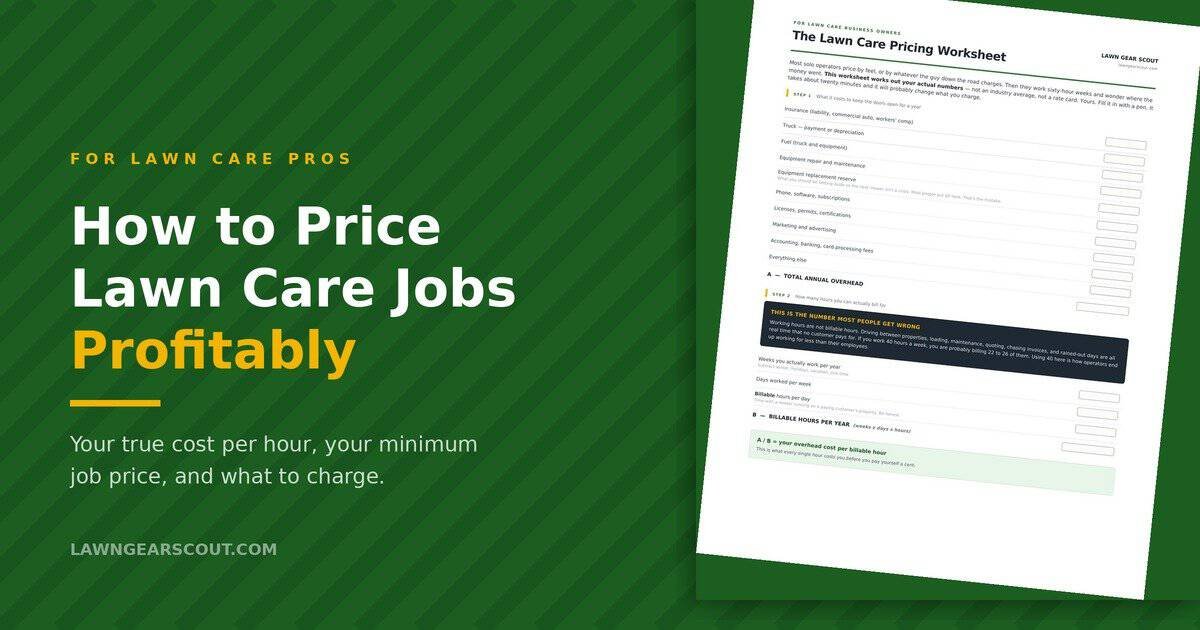
Three pages, fill-in boxes, all the math above laid out step by step. Work out your true cost per hour, your minimum job price, and what to charge.
Lawn business content only — you won’t get homeowner lawn tips.