How to Overseed a Patchy Lawn (Fall 2026 Guide)
A patchy lawn doesn’t need to be torn out and started over. It needs seed put into the ground it already has, at the one time of year the seed will actually take. That’s overseeding, and if you’ve wondered how to overseed a lawn without wasting a $40 bag on grass that never comes up, the answer is almost never about the seed you bought. It’s about timing, soil contact, and water.
Those three things fail in predictable ways. This is the order to do them in and the mistakes that cost people the season.
Why Fall and Not Spring
Spring seeding puts new grass in a race it loses. Crabgrass germinates on the same schedule, summer heat arrives before the roots are deep enough to handle it, and you can’t use crabgrass preventer because it stops your good seed from germinating too.
Fall reverses all three. The soil is still warm from summer, which is what seed actually responds to. The air is cooling, so seedlings aren’t fighting heat stress. Weed pressure has largely collapsed for the year. And the grass that establishes now spends the entire winter putting down roots, so it comes out of spring ahead instead of starting from zero.
The trade-off is that the fall window is short and it closes on a schedule you don’t control.
The Three-Week Window That Decides Whether It Works
Seed germinates on soil temperature, not air temperature. Cool-season grasses want soil between 50 and 65°F at a few inches down. That happens while daytime air sits around 60–75°F, which in most of the northern half of the country means mid-August through mid-September.
The harder constraint is on the other end. New seedlings need roughly 45 days of growing weather before the first hard frost — enough to germinate, root, and take two or three mowings. Seed later than that and you get grass that comes up, looks promising in October, and doesn’t survive the winter.
So the practical rule: find your average first frost date and count back six weeks. That’s your last honest seeding day.
| Region | Overseeding window |
|---|---|
| Upper Midwest, New England, Pacific Northwest | Mid-August to early September |
| Lower Midwest, Mid-Atlantic | Late August to late September |
| Transition zone (KY, TN, northern NC) | September into early October |
| Deep South (warm-season lawns) | Different job entirely — see the note below |
If you have bermuda, zoysia, or St. Augustine, none of the above applies. Warm-season grasses spread by runners rather than seed and are best repaired by plugs or sod. The only thing seeded onto warm-season lawns in fall is annual ryegrass, purely for winter color, and it dies out in spring by design.
How to Overseed a Lawn, Step by Step
1. Match the Seed to What You Already Have
Overseeding a bluegrass lawn with tall fescue gives you a lawn with two textures in it, and it looks like exactly that. Identify what you’re growing before you buy.
Read the seed tag, not the front of the bag. The tag lists the varieties by name, the germination percentage, and — the number most people never look at — the weed seed and other crop seed percentages. Cheap seed is cheap because those numbers are worse. Anything listing “annual ryegrass” high in the mix is a bag you’re paying to plant weeds with.
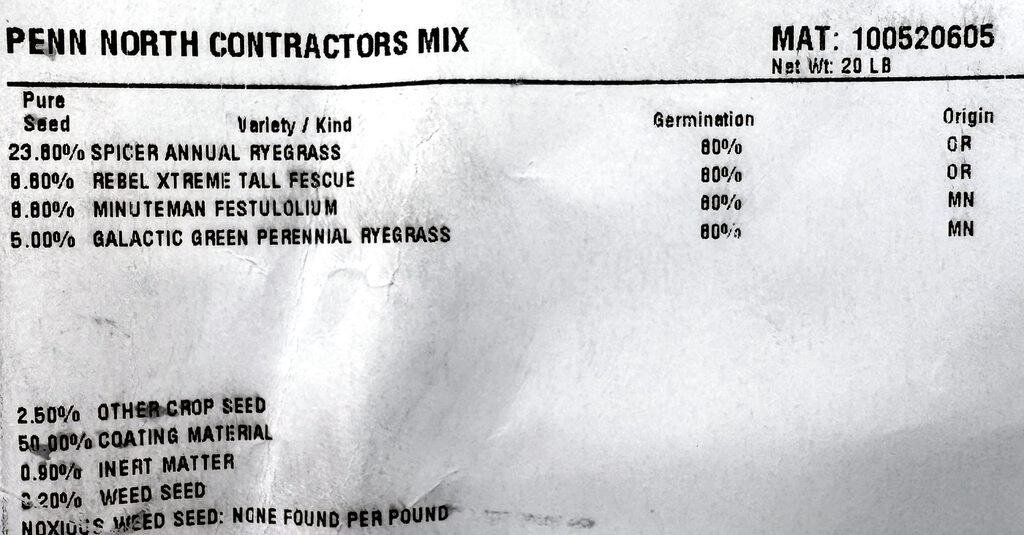
I learned this by getting it wrong. I overseeded in 2024, and maybe a third of it was still there the following summer, and for two years I assumed I’d watered it badly. Then I actually read the tag on the bag I’d used — a contractor’s mix — and did the arithmetic. Half the bag by weight was seed coating. Of the actual seed, the single largest component, more than all the other grasses combined, was annual ryegrass. Annual. It dies at the end of the season by design, which is the entire point of it on a construction site where someone needs green cover before the erosion inspection. It germinated fast, looked excellent in October, and died on schedule. The third that survived was the tall fescue and perennial rye, which was almost exactly the share of the bag they represented.
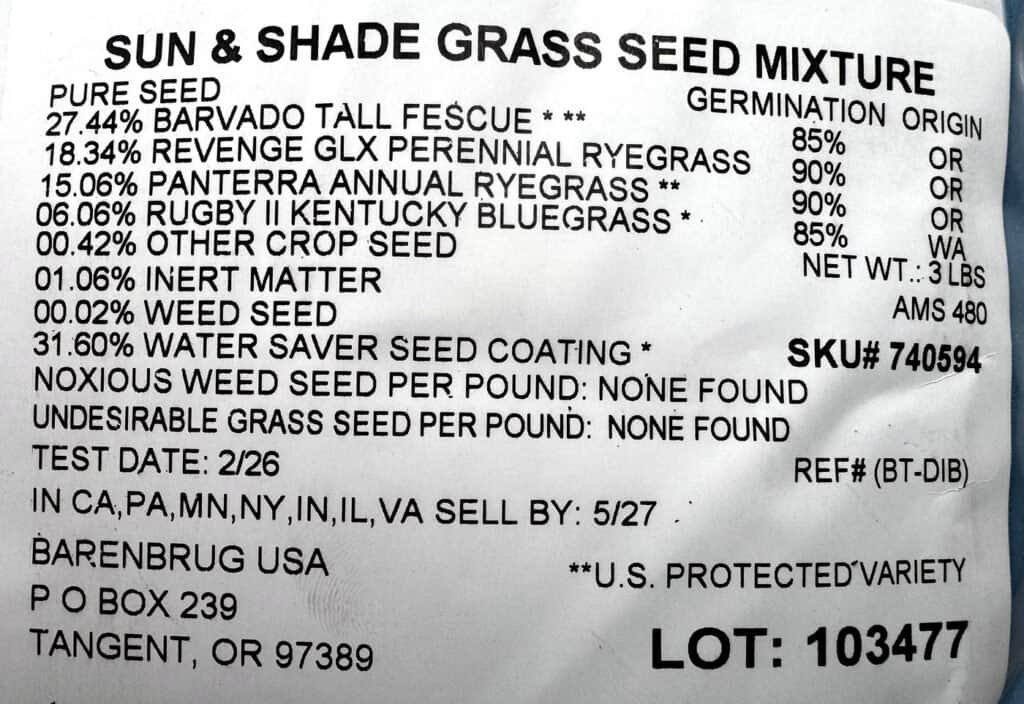
Here’s the bag I replaced it with, and I’m showing it because it isn’t perfect either. Pure seed is up from 46% to 67%, coating is down, weed seed is a tenth of what was in the contractor’s mix, every variety is named, and there’s finally some Kentucky bluegrass in there to spread sideways. But it still carries 15% annual ryegrass — about a fifth of the living seed in the bag. That’s what’s on the shelf at most stores. The point isn’t to find a flawless bag. It’s to know what you’re buying before you spread it, so you’re not surprised in April.
2. Mow Short and Get the Debris Out
Drop the mower to around 2 inches for this one cut, lower than you’d normally run. The point is to get light down to the soil and stop existing grass from shading out the seedlings.
Then rake or bag off everything — clippings, leaves, dead thatch. Seed that lands on a mat of dead material never touches soil, and seed that never touches soil never grows.
3. Open the Ground Up
This is the step people skip, and it’s the one that decides the outcome. Seed lying on top of hard soil dries out between waterings and germinates at maybe a tenth of the rate it should.
Any of these work:
- Core aeration — best option on a full lawn, and it fixes compaction at the same time. Rent it; a machine costs a few hundred dollars to hire for a morning and thousands to own.
- A stiff rake — completely adequate for patching individual bare spots. Scratch the surface until you’ve broken through to loose soil.
- A dethatching rake or verticutter — the middle option if you have a real thatch layer.
For a bare spot specifically, loosen the top inch, seed it, and press the seed in with your foot or the back of the rake. Firm contact, not buried. A quarter inch of soil over the top is plenty; an inch and it never surfaces.
4. Spread at the Overseeding Rate — Not the New-Lawn Rate
Overseeding rates are roughly half of what you’d use on bare ground, because you already have grass there. Doubling up doesn’t give you a thicker lawn. It gives you seedlings competing with each other for the same water and light, and a thinner result than if you’d used less.
| Grass type | Overseeding | New lawn |
|---|---|---|
| Kentucky bluegrass | 1–1.5 lb / 1,000 sq ft | 2–3 lb |
| Perennial ryegrass | 3–5 lb / 1,000 sq ft | 6–8 lb |
| Tall fescue | 4–6 lb / 1,000 sq ft | 8–10 lb |
| Fine fescue | 2.5–4 lb / 1,000 sq ft | 4–5 lb |
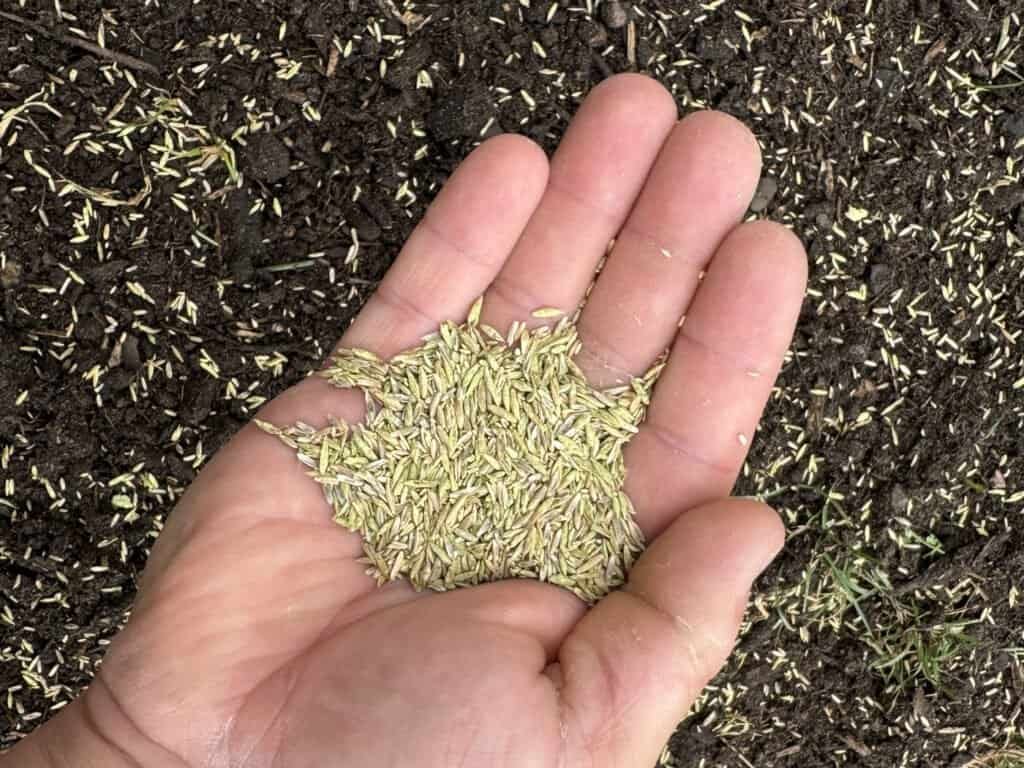
Use a broadcast spreader for a whole lawn and set it to half rate, then go over the area twice in perpendicular directions. Two half passes cover far more evenly than one full one. For a small patch, hand-scattering is fine — aim for seed roughly a quarter-inch apart, close enough to look dense but not a solid layer.
5. Starter Fertilizer, Once
Starter fertilizers carry a high middle number, phosphorus, which is what seedlings use for root development. Apply it at seeding, not before, and not again for six weeks.
One caution: several states restrict phosphorus in lawn fertilizer, with an exemption for establishing or repairing turf. Wisconsin is one of them. You’re generally covered when seeding, but check your own state’s rule rather than assuming — and if you’ve done a soil test showing phosphorus is already adequate, skip it.
6. Water Lightly, Often, and Without Missing a Day
This is where most overseeding actually fails, and it fails fast.
Germinating seed sits in the top quarter-inch of soil. That layer dries out in a couple of hours on a breezy afternoon. If it dries out once after the seed has taken up water and started to swell, the seedling dies. Not set back — dies. You don’t get a second attempt from the same seed.
So: two or three short waterings a day, five to ten minutes each, for two to three weeks. You’re not soaking the ground; you’re keeping the surface damp. One deep soak a day is the wrong shape entirely at this stage.
Once seedlings are up and you’ve mown them twice, flip it — go to deep, infrequent watering, which is what drives roots down.
I also watered that 2024 overseed wrong — long soaks, the way you’d water an established lawn, instead of the short, frequent cycles seed needs. That didn’t help. But it wasn’t the main problem, and I spent two years blaming it for something the bag had already decided.
How long you’re on that schedule depends on what you seeded:
| Grass type | Germination |
|---|---|
| Perennial ryegrass | 5–10 days |
| Tall fescue | 7–14 days |
| Fine fescue | 7–14 days |
| Kentucky bluegrass | 14–28 days |
Bluegrass is the one that catches people out. Three weeks of watering bare-looking dirt feels like failure right up until the day it isn’t. If you seeded a bluegrass blend and nothing has happened by day 12, that’s normal — keep watering.
7. The First Mow
Wait until the new grass is around 3.5 to 4 inches, then cut it back to about 3. Make sure the blade is sharp — a dull blade tears young seedlings out of the ground rather than cutting them, roots and all.
Stay off the area as much as you can until then, and keep the dog off it entirely.
The Five Things That Kill an Overseed
Crabgrass preventer. Pre-emergent herbicide does not know the difference between crabgrass seed and lawn seed. Applying it within about 10–12 weeks of seeding means nothing comes up, and the bag will not tell you that clearly. The one exception is mesotrione-based products, which are labeled for use at seeding on bluegrass, perennial rye, and tall fescue — read the label, and note fine fescue is generally excluded.
Broadleaf weed killer. Same principle, different timing. Wait until you’ve mown the new grass three or four times.
Seed on top of thatch. Covered above, but it’s worth repeating because it looks like you did the job. The seed is there. It’s just not touching anything it can grow in.
One missed day of watering. The single most common cause of “the seed I bought was no good.”
Seeding too late. Grass that germinates in mid-October in a cold climate hasn’t rooted enough to survive frost heave. It looks fine going into winter and it’s gone in March. If you’ve missed the window, wait — dormant seeding in late November, once the ground is too cold for germination, is a real technique and a better bet than a late-October gamble.
What It Costs
For a typical suburban lot, quality seed runs $40–80, starter fertilizer another $20–30, and an aerator rental about $80–100 for half a day. Under $200 for a lawn repair that a landscaper would quote four figures to sod.
The cheapest way to spend that money badly is to buy the seed and skip the aeration and the watering. The seed is the part that doesn’t matter most.
Try This Before You Buy Anything
Walk out to your worst patch and push a screwdriver into the soil. If it goes in six inches with hand pressure, seed will do fine there. If it stops at two, the patch isn’t thin because it’s short of seed — it’s thin because the soil is compacted, and seed scattered on it will do nothing at all.
That thirty-second test tells you whether you’re buying a bag of seed or renting an aerator. It’s the difference between the overseed that works and the one you repeat next year.
The Lawn Product Checklist
What’s actually worth owning, what to skip, and what to rent instead of buy — for a normal residential lawn.
Similar Posts
What the Numbers on a Fertilizer Bag Mean
Stand in the fertilizer aisle long enough, and you notice the numbers don’t agree with each other. One bag says 22-0-12. The next says 10-10-10. The one on the end shelf says 32-0-4 and costs less than either. Same aisle, same season, same lawn they’re all meant for. Those three numbers are the most useful…