What the Numbers on a Fertilizer Bag Mean
Stand in the fertilizer aisle long enough, and you notice the numbers don’t agree with each other. One bag says 22-0-12. The next says 10-10-10. The one on the end shelf says 32-0-4 and costs less than either. Same aisle, same season, same lawn they’re all meant for.
Those three numbers are the most useful thing printed on the bag, and almost nobody reads them. What the numbers on a fertilizer bag mean is simple enough to cover in one sentence — they’re percentages of three nutrients — but the useful part is what you do with them. Once you can read a bag, two things happen. You stop buying by brand, and you stop overpaying — because the cheapest bag on the shelf is frequently the most expensive fertilizer in the store.
Here’s the whole label, in order of how much it actually matters.
What Do the Numbers on a Fertilizer Bag Mean?
They’re always nitrogen, phosphorus, and potassium, always in that order, on every bag of fertilizer sold in the country. N-P-K.
Each number is a percentage by weight. That’s the part people miss. A 50-pound bag of 22-0-12 is 22% nitrogen — eleven actual pounds of nitrogen. It is not “a bag of 22.” Another six pounds is potash, and three and a half is sulfur, and the remaining thirty or so pounds are carrier: the ground-up material that lets the good stuff spread evenly instead of landing in clumps.
One technicality, because you’ll run into it eventually. The first number is nitrogen straight. The middle and last numbers are reported as phosphate and potash rather than pure phosphorus and potassium, which is a chemistry convention from a century ago that nobody has bothered to change. It matters if you’re comparing a bag against a soil test report. It doesn’t matter for anything you’re deciding in the aisle.
What About a Fourth Number?
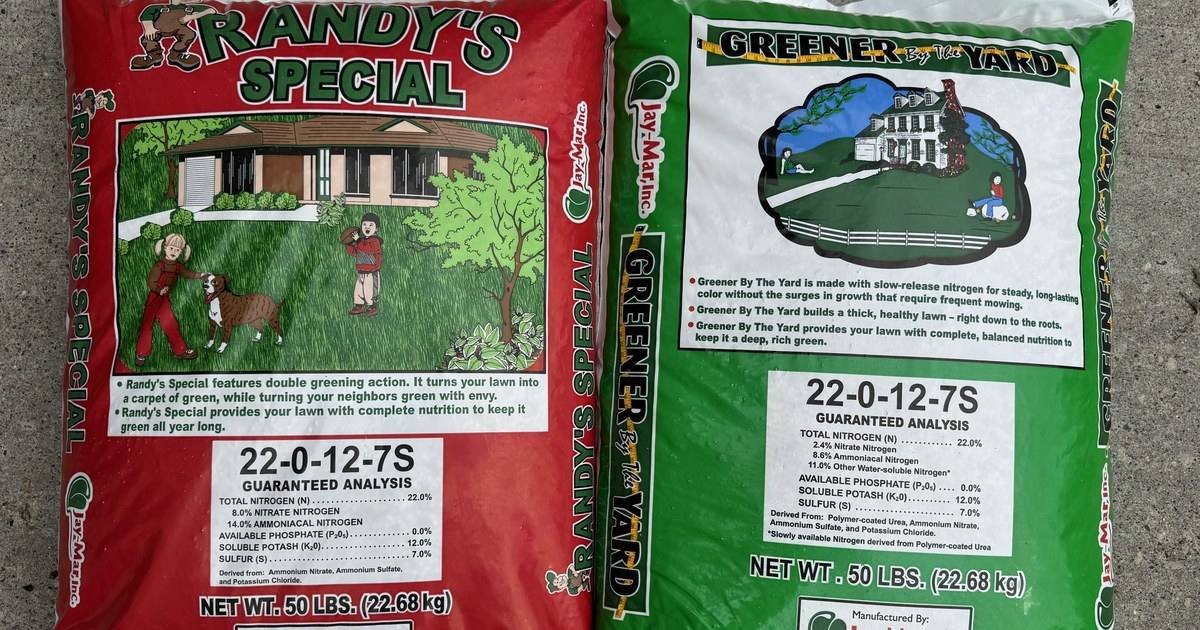
Some bags carry four. The pair in the photo above both read 22-0-12-7S, and that last figure is sulfur — seven percent of the bag by weight, same as every other number on the label.
Sulfur is worth having. It supports chlorophyll production, which means it contributes to color the way nitrogen does but without pushing growth, and cool-season lawns in the upper Midwest are frequently short of it. If you’re choosing between two otherwise identical bags and one carries sulfur, take that one.
Nitrogen Is the Number That Changes What You See
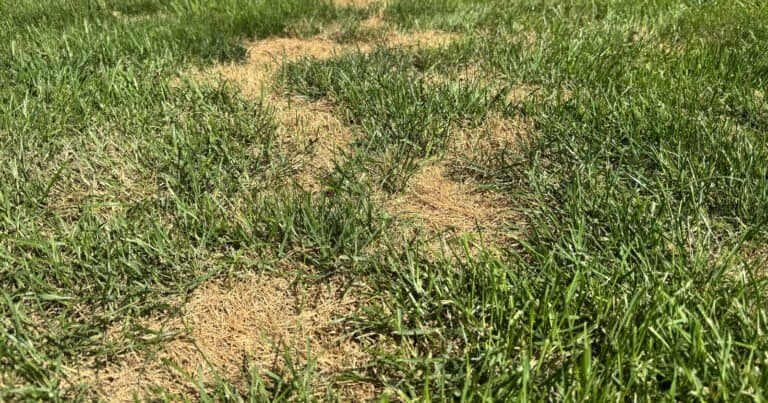
Nitrogen drives color and blade growth. It’s the number responsible for the change you notice three days after an application — the lawn darkens and starts growing hard.
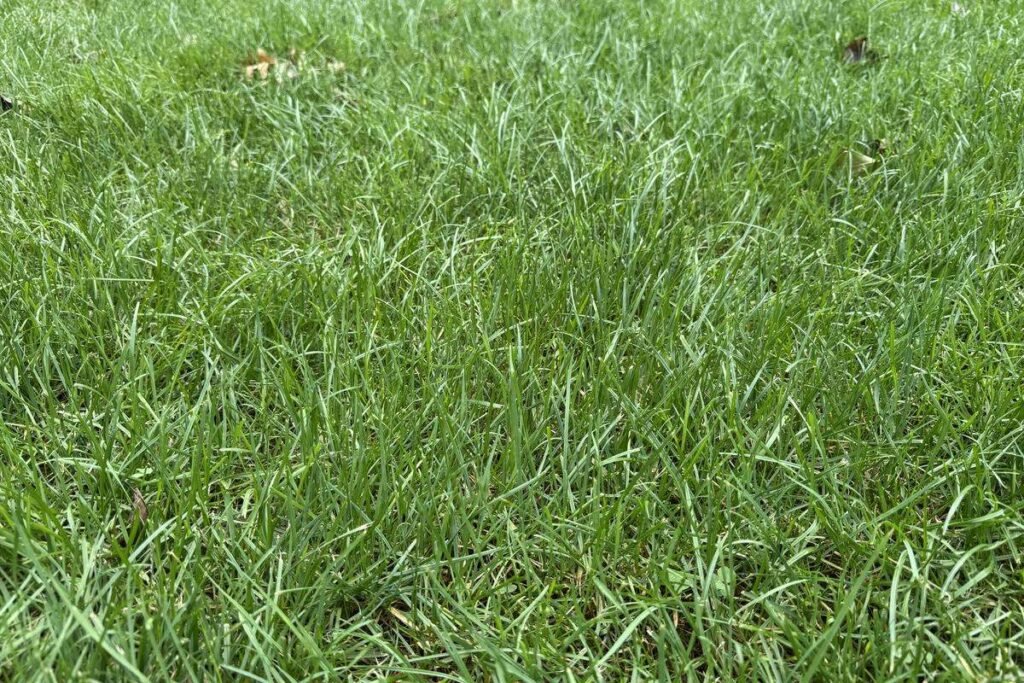
Which is exactly why it’s the number people get wrong. More nitrogen is not better nitrogen. Overdo it, and you get a surge of soft top growth that the root system hasn’t grown to support, a mower you’re now running twice a week, more disease pressure, and on a hot week, burn.
The rate that turf research settled on decades ago and that nobody has improved on: about one pound of actual nitrogen per 1,000 square feet per application, and somewhere between two and four pounds per 1,000 square feet across a whole year for cool-season grass. Less if the lawn is in shade. Less if you leave the clippings, which you should — clippings return roughly a quarter of the nitrogen you put down.
This isn’t my number. UW–Madison’s Division of Extension publishes fertilizer guidance written specifically for Wisconsin lawns, and their lawn maintenance publication is worth reading before you buy anything. For the deeper version, Lawn Fertilization (A2303) is a free download from the Extension Learning Store.
The Math That Turns a Bag Into a Plan
Two lines of arithmetic, and it’s the only math in this article:
Bag weight × first number ÷ 100 = pounds of nitrogen in the bag
Pounds of nitrogen ÷ the pound-per-1,000 rate = square feet the bag covers
So a 50-pound bag of 22-0-12 holds 11 pounds of nitrogen and covers 11,000 square feet at a full-pound rate. If your lawn is 8,000 square feet, one bag is one application with a little left over.
Now run it on price, which is where this gets useful. Divide what the bag costs by the pounds of nitrogen inside it:
- A 50 lb bag of 22-0-12 at $28 — 11 lbs of nitrogen — $2.55 per pound of nitrogen
- A 16 lb bag of 10-0-4 at $18 — 1.6 lbs of nitrogen — $11.25 per pound of nitrogen
The second bag looks cheaper on the shelf tag and costs more than four times as much for the thing you’re buying. That gap is the entire reason to learn to read the numbers. Small bags of low-analysis fertilizer are the most reliably bad value in the lawn aisle, and they’re stacked at eye level for a reason.
Cost per pound of nitrogen is the comparison. Write it on your phone in the aisle if you have to.
Fertilizer Cost Calculator
Shelf price tells you almost nothing. Enter two bags and see what each one really costs for the thing you’re buying — nitrogen.
Bag A
Bag B
Nitrogen is the first of the three numbers on the bag. This compares bags on the nutrient you’re actually paying for — it doesn’t account for slow-release percentage, which you’ll find on the back and which is worth paying more for. Coverage assumes a one-pound-per-1,000-square-feet application rate.
Phosphorus — The Middle Number, and Why It’s Usually Zero
Phosphorus supports root development and seedling establishment. It’s genuinely important, and your established lawn almost certainly has enough of it already. Phosphorus binds tightly to soil and doesn’t wash out the way nitrogen does, so decades of applications accumulate. Most mature lawns test adequate or high.
There’s also a legal layer, which is the part that surprises people. Wisconsin has restricted phosphorus fertilizer on turf since April 2010. State statute 94.643 limits the use, sale, and display of lawn and turf fertilizer labeled as containing phosphorus or available phosphate, with two exemptions: establishing new grass from seed or sod during that growing season, and applying it to an area that a lab soil test performed within the previous 36 months shows to be deficient. Minnesota and New York have similar laws, and a number of counties elsewhere do too.
The same statute prohibits applying any turf fertilizer to frozen ground, and requires you to sweep up anything that lands on a driveway or sidewalk rather than leaving it to wash into a storm drain. Both rules exist for the same reason the phosphorus limit does: runoff into lakes feeds algae blooms.
So when you see a zero in the middle, it isn’t a defect or a cheap bag. It’s the default for a reason, and it’s why both bags in the photo read zero. The only way to justify buying phosphorus for an established lawn is a soil test that says you need it — which, in this state, is also the only way to legally buy it for that purpose. A lawn you’re seeding this fall is the exception, and the starter fertilizer aisle is where you’ll find the bags that carry a middle number.
Potassium — The Third Number
Potassium is the one nobody photographs. It doesn’t change the color of anything this week. What it does is regulate water use and harden the plant off against cold, drought, and disease.
You’ll see it show up in the fall bags at somewhere between 4% and 12%, and that’s where it earns its keep in the north. The lawn that goes into a Wisconsin winter with adequate potassium comes out of it in better shape than the one that went in fed on nitrogen alone. It’s the least visible number on the bag and the one I’d argue least about paying for.
The Line on the Back That Matters More Than the Numbers on the Front
Flip the bag over and find the guaranteed analysis, then look for a phrase like “slowly available nitrogen” with a percentage next to it, and the “derived from” list underneath.
Quick-release nitrogen — usually plain urea, ammonium nitrate, or ammonium sulfate — dissolves and is available almost immediately. Fast green-up, three to four weeks of effect, and every bit of the burn risk.
Slow-release nitrogen — sulfur-coated urea, polymer-coated urea, methylene urea, or anything sold as “stabilized” — meters itself out over eight to twelve weeks. Slower to show, much harder to burn with, and it doesn’t hand the lawn a growth surge it has to survive.
Look at the two bags again. Both read 22-0-12-7S. Same numbers, same fifty pounds, same manufacturer in Plover. Then read the derived-from lines: the green bag is polymer-coated urea, so its nitrogen releases over weeks, and it says so on the label — slow-release nitrogen for steady color without the growth surge. The red bag is ammonium nitrate and ammonium sulfate, which are available the moment they get wet.
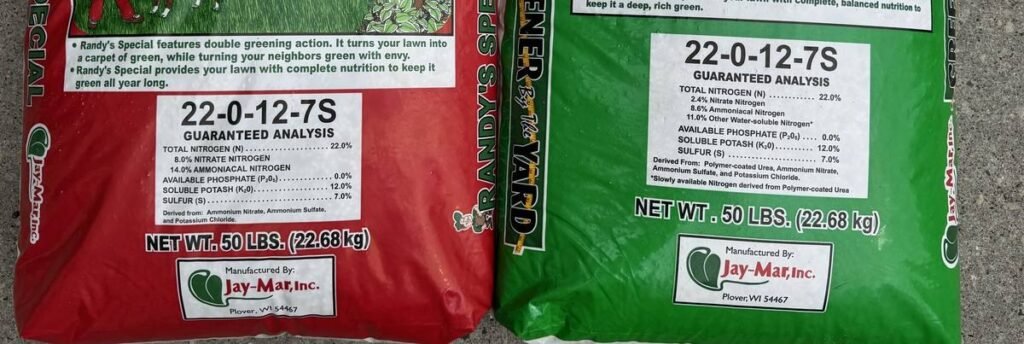
Two products with identical front labels that do genuinely different things to your lawn. That’s the whole argument for turning the bag over. The front of the bag will never tell you which one you’re holding.
Both of these come from Jay-Mar in Plover, WI, about twenty minutes from my driveway. That’s worth mentioning because regional fertilizer blends are formulated for regional soil, and a bag mixed for central Wisconsin sand is a different product from whatever a national brand ships to every state at once. If you’re local, the co-op shelf is usually a better place to look than the big-box aisle.
Weed and Feed Is a Different Product Wearing the Same Numbers
Anything labeled weed and feed is fertilizer plus a herbicide, and the herbicide sets the schedule, not the N-P-K. The timing that suits the weed rarely suits the grass, and if you’ve put down seed in the last two months, a pre-emergent in the bag will stop it from germinating exactly as designed.
Buy fertilizer and weed control separately. You’ll apply each one when it should be applied, and you’ll usually spend less. If you put seed down this month, that timing question is covered in more detail in how to overseed a patchy lawn.
What I Put Down, and When
To be specific: my lawn is roughly 10,000 square feet in Amherst Junction, in Portage County, mostly Kentucky bluegrass. I used the green bag — the polymer-coated one — at 5-6 on a Scotts Deluxe rotary spreader, applied on 9-2-26, with the clippings left on the lawn.
One 50-pound bag at that rate covered 10,000 square feet, which for my yard is one full application. I paid $28.00 for it at Jay-Mar, which works out to $2.55 per pound of nitrogen.
What the Numbers Should Look Like Right Now
September and October are the most valuable feeding window of the year for cool-season grass in the north — better than anything you do in spring. The soil is still warm, the air isn’t, and the plant puts what you give it into roots and crown rather than into top growth you then have to mow.
What to look for on the shelf this month:
- A first number in the 20s or higher, with a meaningful slow-release share
- A zero in the middle, unless you’ve just seeded or have a soil test in hand
- A third number that isn’t zero
- Sulfur on the label if it’s offered
- Roughly one pound of nitrogen per 1,000 square feet per application, once in early September and again in late October
Set the spreader to the rate on the bag for your model, not to the middle setting, and walk at a normal pace. Bag rates assume you’re moving, not strolling.
I’d been buying the wrong one of these two bags for years, and the front label gave me no reason to think so. Identical numbers, red one two dollars cheaper. It wasn’t until I read the guaranteed analysis that I understood I’d been paying slightly less for quick-release nitrogen every spring. The green bag has worked better on my lawn since I switched.
The Short Version
- The three numbers are percentages by weight of nitrogen, phosphorus, and potassium; a fourth is usually sulfur
- Nitrogen is the one you see; hold it to about a pound per 1,000 square feet per application
- Compare bags on cost per pound of nitrogen, never on shelf price
- Zero phosphorus is normal, and in Wisconsin it’s the law unless you’re seeding or holding a soil test
- The derived-from line on the back tells you more than the numbers on the front — two bags with the same analysis can behave completely differently
The next thing worth doing is finding out what your soil actually has, which costs about fifteen dollars and takes twenty minutes. That’s the next article.
The Lawn Product Checklist
What to actually buy, what to skip, and what the label should say — a one-page checklist you can take to the store.